
Find the Noise First
A garage door makes a handful of distinct sounds, and each points at a different part. Stand inside with the door running and listen for where the sound is loudest. Then disconnect the opener with the red cord and lift the door by hand. If it is quiet by hand, the opener is the source. If it is still loud, the door is.
| Sound | Where it comes from | Fix | Yours or ours? |
|---|---|---|---|
| A rumble or roar that shakes the ceiling | Chain drive opener and its rail mounts feeding vibration into the joists | Belt drive opener, or rubber isolators on the existing mounts | Ours |
| Grinding or scraping as the door moves | Steel rollers on steel track, or worn open bearings | Sealed nylon rollers as a full set | Ours |
| Squeak or squeal at the hinge line | Dry hinge pivots and roller stems | Silicone spray or white lithium grease | Yours |
| Rattle or clatter over bumps in travel | Loose hinge nuts, track brackets or panel screws | Tighten every fastener you can reach | Yours |
| A single pop or bang when the door starts | Spring coils binding on the shaft, or a roller jumping a dent in the track | Lubricate the spring; inspect the track | Yours, then ours if it persists |
| A slap or thud at the top of travel | Door hitting the opener's stop; travel limit set too far | Adjust the up limit | Either |
| A gunshot bang, then the door will not lift | A torsion spring has broken | Replace both springs | Ours, and do not use the door |
Nylon Rollers: The Biggest Single Improvement
Swapping builder-grade steel or plastic rollers for sealed-bearing nylon rollers is the single change that quiets most doors, and a full set of 10 to 12 runs about $120 to $250 installed as an estimate. Nylon wheels do not ring against the steel track, and the sealed bearings do not need the grease that humid garages wash out.
Not all nylon rollers are equal. Look for a sealed bearing with 10 or 13 balls rather than an open one, a stem long enough for your hinge type, and a wheel rated for the weight of the door. A cheap nylon roller with an open bearing will be quiet for a year and then grind like the steel one it replaced. The good ones commonly carry a rating of 100,000 cycles or more, which on a normal household door is longer than the door will last.
The bottom rollers sit in the bottom brackets, which carry the full spring tension through the cables. That is why a roller swap is a technician job even though the middle hinges are easy. While the rollers are out we also check the top roller brackets, which set how tightly the top section seals against the header, and adjust them if the door has been slapping the stop molding.
Chain Drive, Belt Drive or Wall-Mount?
A chain drive is the loudest and cheapest opener; a belt drive does the same job with a reinforced rubber belt and is dramatically quieter; a wall-mount jackshaft unit removes the rail from the ceiling entirely. New openers installed run roughly $400 to $800 depending on drive type and features, with belt drives in the middle of that range. Whichever you choose, a new opener has to meet the federal opener rule, 16 CFR 1211.
| Drive type | Noise | Worth knowing |
|---|---|---|
| Chain drive | Loudest, a steel chain over a steel sprocket | Fine in a detached garage; the noise travels through the rail mounts into the ceiling of an attached one |
| Belt drive | Quiet; DC motor versions with soft start and stop are quieter still | Same rail and same install as a chain drive, so swapping is straightforward |
| Screw drive | Moderate; a single threaded rod with no chain | Rarely sold now and sensitive to temperature swings, which we have plenty of |
| Wall-mount jackshaft | Quietest at the ceiling, because there is no rail overhead | Mounts beside the torsion shaft, so it needs torsion springs and side room; LiftMaster and Genie both make them |
Our opener repair and replacement page goes into brands and what fails on each. The short version for noise is that a belt drive on rubber isolators, driving a door on nylon rollers, is as quiet as a sectional garage door gets.
The Ten Minute Tighten-and-Lube Pass
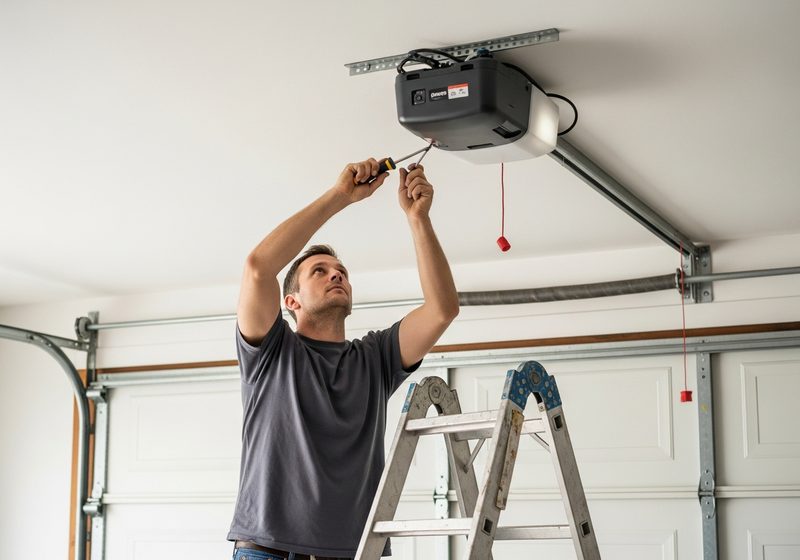
Unplug the opener, leave the door down, and work along it from bottom to top. Snug the nuts on every hinge, because they loosen a fraction with every cycle and a loose hinge rattles. Check the lag screws holding the track brackets to the jambs and the bolts on the opener's header bracket and ceiling hangers. Snug is the goal, not tight; over-torquing a lag screw in damp jamb wood strips the hole.
Then lubricate the hinges, the roller bearings, the springs and the bearing plates at each end of the shaft with silicone or white lithium grease, and wipe the tracks clean and dry. The full where-and-what is in our guide to a door that sticks in humid weather, and it doubles as the noise routine. Heat is part of why it matters here: with around a hundred days a year at or above 90 degrees, grease thins and runs off hardware faster than in most of the country. DASMA's data sheet on spring cycle life counts regular lubrication among the habits that get a spring to its rated life.
Want it quiet by tonight?
Rollers, tune-up and an opener recommendation in one visit, with a firm price before we start.
Isolation Kits and the Bedroom Above the Garage
Sugar Land is a city of master-planned communities, and since First Colony broke ground in 1977 the standard plan has put an attached two-car garage under or beside a bedroom. The opener bolts to the ceiling joists through steel angle iron, so every vibration in the motor and rail goes straight into the floor above. The rumble people complain about is rarely airborne; it is structural.
An isolation kit breaks that path. Rubber bushings or pads sit between the opener chassis and the hangers, and sometimes between the hangers and the joists, so the vibration is absorbed before it reaches the framing. Kits cost little, install in half an hour, and make a chain drive noticeably more tolerable while you decide about a belt drive. We also check that the hangers are braced diagonally and that the rail is not touching drywall anywhere along its length, because a rail resting on a ceiling is a drum.
An insulated door helps too. Polyurethane-cored sections are stiffer and quieter than single-skin steel, which is one of the points in our comparison of garage door materials for a humid climate.
Noises That Mean Stop, Not Lubricate
Some sounds are not maintenance items. A single loud bang, after which the opener strains and the door barely moves, is a broken torsion spring. Do not pull the release to lift it; a double door with no counterbalance weighs 150 pounds or more. That is a call to our spring repair line and both springs get replaced together.
Grinding from the opener head while the door sits still means the drive gear has stripped, which is a repair rather than a replacement on most units. A scraping sound paired with a door hanging crooked in the opening means a lift cable has snapped or jumped its drum, and the door should not be run again until it has been seen for cable repair. Repeated popping from one side of the track usually means a roller has worn through or a track has been dented, and the next stop is the door leaving the track altogether.
Corroded bearings and rusted hinge knuckles are their own noise source in this climate, which is why the noise routine and the rust routine are the same twice-a-year job; our guide to rust on garage door hardware covers what to look for. When the door is doing something on this list, or you would just like it quiet without doing the work yourself, our main page on garage door repair in Sugar Land has the price ranges and the number to call.