
How Photo Eyes Work, and Why Sun Confuses Them
Every residential opener sold in the US since January 1, 1993 has to carry photo-eye sensors under UL 325, mounted no more than 6 inches above the floor. One eye sends an infrared beam and the other receives it. Sunlight is full of infrared, so a receiver facing a low sun loses the beam and the opener refuses to close.
The receiver is designed to recognize a specific pulsed signal from its partner. Flood it with enough stray light and it can no longer pick that signal out, which the opener treats as an obstruction. Depending on the model, the door either will not start closing, or starts and then reverses back up, and the opener light usually flashes a warning. Many LiftMaster and Chamberlain units flash ten times; check the manual for yours.
There is a quick way to confirm the sensors are the reason. If the door closes when you press and hold the wall button, but not from the remote or a single press, the opener is being told the beam is broken. That constant-pressure close bypasses the eyes, so use it only when you can see the opening is empty, and only as a test.
Is It the Sun or Something Else?
| What the door does | Most likely cause | Fix |
|---|---|---|
| Fails only in late afternoon, fine at night and in the morning | Sun on the receiving eye | Shade test, then shield or swap the eyes |
| Fails at any hour; one eye's light is off or flickering | Eyes knocked out of alignment | Realign until both lights are steady |
| Fails at random, worse after rain or storms | Corroded or loose wiring, water in a splice | Rewire from the eyes to the opener terminals |
| One eye's light is completely dark | Broken wire, no power to that eye, or a failed eye | Check the wiring first, then replace the pair |
| Both lights steady, door still reverses just before the floor | Down travel limit set too far, or the bottom seal too tall | Adjust the travel limit |
| Both lights steady, door reverses only when it touches something | Working as designed | Clear the obstruction; adjust force only if the floor is clear |
Why Late Afternoon Is the Problem in Sugar Land
The city sits at about 29.6 degrees north, and in June and July the sun sets a little after 8 pm, well north of due west. That puts a low, bright sun straight down the driveway of any west or northwest facing garage right through the evening commute, which is exactly when most doors get used. Fort Bend County is flat, with almost nothing on the horizon to block it, so the last hour of sun arrives at floor level unfiltered.
Light-colored concrete makes it worse by bouncing sun up into an eye that is not even facing west. A white or silver car parked on the drive does the same. If the door started misbehaving after the driveway was pressure washed or a new car arrived, that is not a coincidence.
Five Fixes, Cheapest First
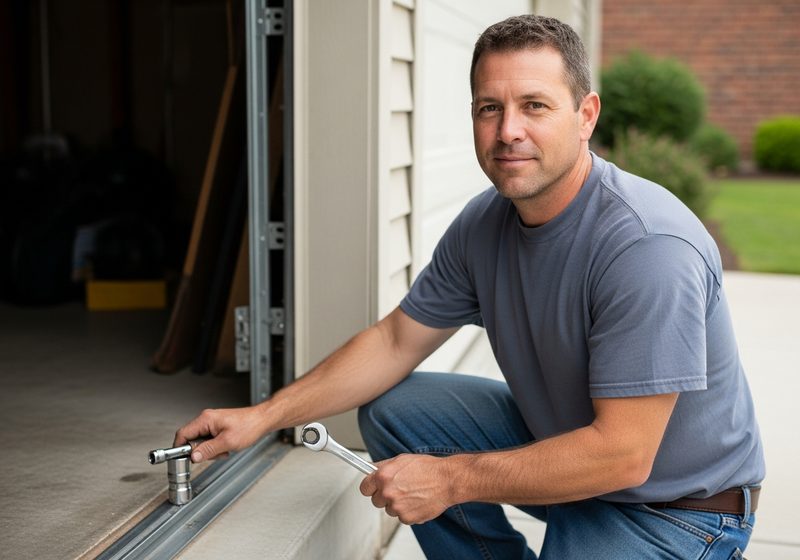
Start with a 10 minute test: hold a piece of cardboard to shade the receiving eye at the time the door usually fails. If it closes, the sun is the problem. Then work through a sun shield, swapping the sending and receiving eyes so the receiver faces away from the sun, a small realignment, and finally a replacement pair.
- The shade test. Stand clear of the opening, shade the receiver with your hand or a piece of cardboard, and press the remote. If the door now closes, you have your diagnosis for free.
- A sun shield. Manufacturers sell small hoods that clip over the eye, and a short length of dark PVC pipe or cardboard tube slipped over the receiver does the same job. It narrows the receiver's view to the beam and nothing else.
- Swap the eyes. Only the receiver cares about sun. Moving the receiving eye to the side of the garage that faces away from the setting sun, and the sender to the sunny side, often ends the problem for good. The wires simply go with each eye, so make sure there is enough slack to reach.
- Realign. An eye that is very slightly off aim is already marginal, and a little glare pushes it over. The steps are below.
- Replace the pair. Older eyes lose sensitivity and newer designs filter stray light better. A replacement pair, installed and aligned, sits inside our normal opener repair range of about $125 to $350.
Realigning the Sensors Step by Step
Alignment takes 10 minutes and a tape measure. Measure the height of each eye from the floor and make them match, then loosen the wing nut on the misbehaving eye and pivot it slowly until its indicator light turns solid. Tighten the nut without moving the eye, and check the light again. Both eyes should now show steady lights. Chamberlain's troubleshooting guide has photos of the same LED checks.
Two rules. Keep both eyes at or below 6 inches from the floor, because that height is what lets the beam catch a child or a pet lying in the opening. And after any sensor work, close the door on a 2 by 4 laid flat on the floor. The door must reverse when it touches the board. That monthly test is the one that matters most, and it takes thirty seconds.
Sensors still arguing with the sunset?
We carry replacement eyes and shields on the truck and can usually have the door closing reliably again in one visit.
Wiring Problems That Look Like Sun
Once the time-of-day pattern is ruled out, wiring is the next suspect, and Gulf Coast humidity gives it plenty of help. The thin bell wire from each eye runs along the wall to two terminals on the opener head. Staples driven through the insulation, splices twisted together behind drywall, and green corrosion on the terminals all produce a beam that comes and goes. So does a wire pinched under a track bracket when the tracks were last adjusted.
The clue is randomness. Sun fails on a schedule. Bad wiring fails when the garage warms up, when it rains, or when the door's vibration shakes a loose connection. Tug gently on each wire at the eye and at the opener while watching the lights. If a light flickers, you have found it. Replacing the wire end to end is cheaper than tracing it, and it is standard on any flood cleanup, which is covered in our guide to what to check on a garage door after flooding.
Two other things impersonate a sensor fault. A door that has picked up drag from humidity or dry rollers can trip the opener's force setting and reverse, which our guide to a door that sticks in humid weather walks through. And a logic board damaged by a lightning surge can throw sensor errors with perfectly good eyes. If the door is stuck open after dark and nothing on this page has moved it, our 24 hour emergency line exists for exactly that. For the rest of what can go wrong with an opener, see our main page on garage door repair in Sugar Land, TX.