
Why the Garage Door Is the Weak Point in a Storm
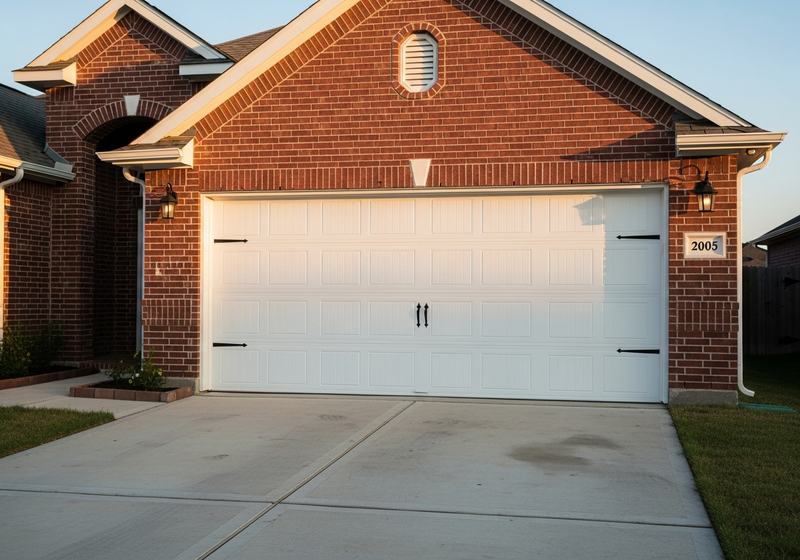
A standard double garage door is about 16 feet wide and 7 feet tall, 112 square feet of thin steel held only by rollers in light track. Wind pushing on that area bows the sections inward, the rollers pull out, and the door folds. Once wind enters the garage it pressurizes the house from inside and can lift the roof.
That chain of events is not a theory. FEMA's post-storm building assessments have documented garage door failure as a starting point for structural damage for decades, which is why the agency's guidance on hurricane retrofits gives the garage door its own section. Nothing else on the house combines that much area with that little stiffness.
Wind works on the door in both directions. On the windward side of the house it pushes in. On the leeward side it pulls out, and suction is what drags rollers out of the track on a door that looked fine a moment earlier. Then there is debris, which turns a strong door into a dented one and a weak door into an open one. DASMA's note on garage doors in high wind events makes the same point: positive and negative pressure ratings both matter.
Does a Sugar Land Home Need a Wind-Rated Garage Door?
Not by law. Sugar Land sits in Fort Bend County, outside the 14 coastal counties the Texas Windstorm Insurance Association covers, so no windstorm certificate is required here and a standard door is legal to install. It is still a sensible upgrade, because tropical systems that reach the city bring winds a builder-grade door was never designed to hold.
A wind-rated door is built and labeled to a design pressure following DASMA and ASCE 7 standards. The label lists a positive and a negative pressure in pounds per square foot. To get there the manufacturer adds horizontal struts across each section, uses heavier gauge track, adds rollers and fasteners, and reinforces the end stiles where the hinges bolt through. It looks like a normal door from the street.
The thing to remember about this part of the Gulf Coast is that the wind and the water are separate problems. Harvey in August 2017 was mostly a rain event for Fort Bend County, dropping well over 30 inches on parts of the county, and the door hardware we replaced afterward was flood damaged rather than wind damaged. Other storms have done the opposite. Preparing for one and not the other is a gamble.
Wind-Rated Door vs Bracing Kit vs Doing Nothing
There are really three choices, and the right one depends on how old the door is and whether you were going to replace it anyway.
| Option | What it is | Typical cost | What it buys you | Downside |
|---|---|---|---|---|
| Wind-rated replacement door | A new door built, tested and labeled to a design pressure, with matching track and hardware | $1,400 to $3,500 for most steel doors, with the rating pushing toward the upper end | The strongest and only certifiable option, and it is permanent | Only makes sense when the door is due for replacement anyway |
| Retrofit bracing kit | Vertical posts pinned to the floor and header with the sections tied to them, or added struts and heavier fasteners | Typically a few hundred dollars installed, quoted after we see the door | A large strength increase on an existing door | No official rating; post kits must be fitted before each storm |
| Added horizontal struts only | One or two steel struts bolted across the inside of the weakest sections | The lowest cost option | Stops sections sagging and buys some stiffness | Partial protection; rollers can still pull out |
| Do nothing | A builder-grade door on standard track | Nothing today | Nothing | The door and the roof above it are both at risk |
What a Bracing Kit Actually Does
The most common retrofit is a vertical post system. Two or three steel posts stand inside the door, from the floor to the header. Each post is anchored into a sleeve set in the slab and a bracket on the header, and the door sections clip or pin to the posts at each joint. Wind load then travels into the concrete and the framing instead of into the rollers and track.
Post kits are usually fitted a day before a storm and stored the rest of the year, because they block the door from opening. Permanent strut systems work differently. They add horizontal steel across the inside face of each section, replace light hinges with heavier ones, and add fasteners through the end stiles. The door still operates normally, but each section is far stiffer under load.
Either kind of bracing adds weight to the door, and weight has to be counterbalanced. A properly fitted kit is followed by a balance check, and sometimes by a heavier spring. Skipping that step leaves the opener dragging a door it cannot lift. If you already suspect the springs are tired, read about spring replacement before adding bracing.
Pre-Storm Checklist for the Garage Door
Hurricane season runs June 1 to November 30, and the useful work happens before a storm is named. In an hour you can do the balance test, tighten every hinge and track bolt, confirm the rollers sit fully in the track, close and lock the door, park inside, and locate the red release cord in case the power goes out.
- Balance test. With the door closed, pull the release cord, lift the door to about waist height and let go. A balanced door stays put. If it drifts down or feels heavy, the springs need adjusting, which is a job for us rather than a wrench.
- Tighten the hardware. Snug the nuts on every hinge, the lag screws on the track brackets, and the bolts on the opener's header bracket. Do not touch the set screws on the spring cones or the cable drums.
- Check the rollers and track. Every roller should sit fully inside the channel. Look for spread track, dents and brackets that have pulled away from the jamb.
- Add struts if the sections flex. Push on the middle of the widest section. Visible flex means it will bow badly in wind and would benefit from a strut.
- Close and lock. If you disconnect the opener, engage the slide lock on the door. If the opener stays connected, do not engage the lock, because the motor will try to lift against it and strip its own gear.
- Clear the garage of anything the door could hit if it does bow inward, and park the car inside if it fits.
Rather have it checked by someone who does this daily?
A pre-season inspection covers balance, hardware, rollers and track, with bracing options priced on the spot.
After the Storm: Check Before You Press the Button
Once the wind has passed, look before you operate. Stand inside with the door closed and check that the sections sit flat, the rollers are still in the track and the door is not racked to one side. A bowed section or a roller out of the channel means the door needs attention before it moves, because forcing it can pull the whole thing down. Our page on off-track door repair explains what happens next.
Check the floor. Much of Sugar Land sits behind the levee improvement districts along the Brazos, so river flooding reaches fewer garages than people expect, but wind-driven rain gets under a bottom seal in almost every serious storm. If there is water or silt inside, work through our guide to what to check on a garage door after flooding before using the opener. FEMA's flood maps show whether your street is in a mapped flood zone.
Finally, the opener itself. Power surges during outages take out logic boards regularly, and a unit that is dead the morning after a storm usually has a board problem rather than a motor problem. Our opener repair page covers the symptoms. If the door is stuck open and the house is exposed, that counts as an emergency and we answer the line at any hour. Everything else about garage door repair in Sugar Land, TX starts on our main page.
If the storm has convinced you to replace the door, our guide to choosing a garage door material for a humid climate covers which options take a wind rating well and which corrode first.